The XRP Ledger has everything you'd want in a blockchain: speed, reliability, efficiency, and low cost. But the area where it needs a slight focus is volume - not of transactions, but of builders.
Too many still think XRPL development requires deep coding expertise. That mindset is outdated. With today’s AI tools, it’s entirely possible to build functional, user-facing products without a traditional software background.
One day, I set myself a challenge to create a functional dApp exploring so-called “vibe coding” in one week. And that’s exactly what I did.
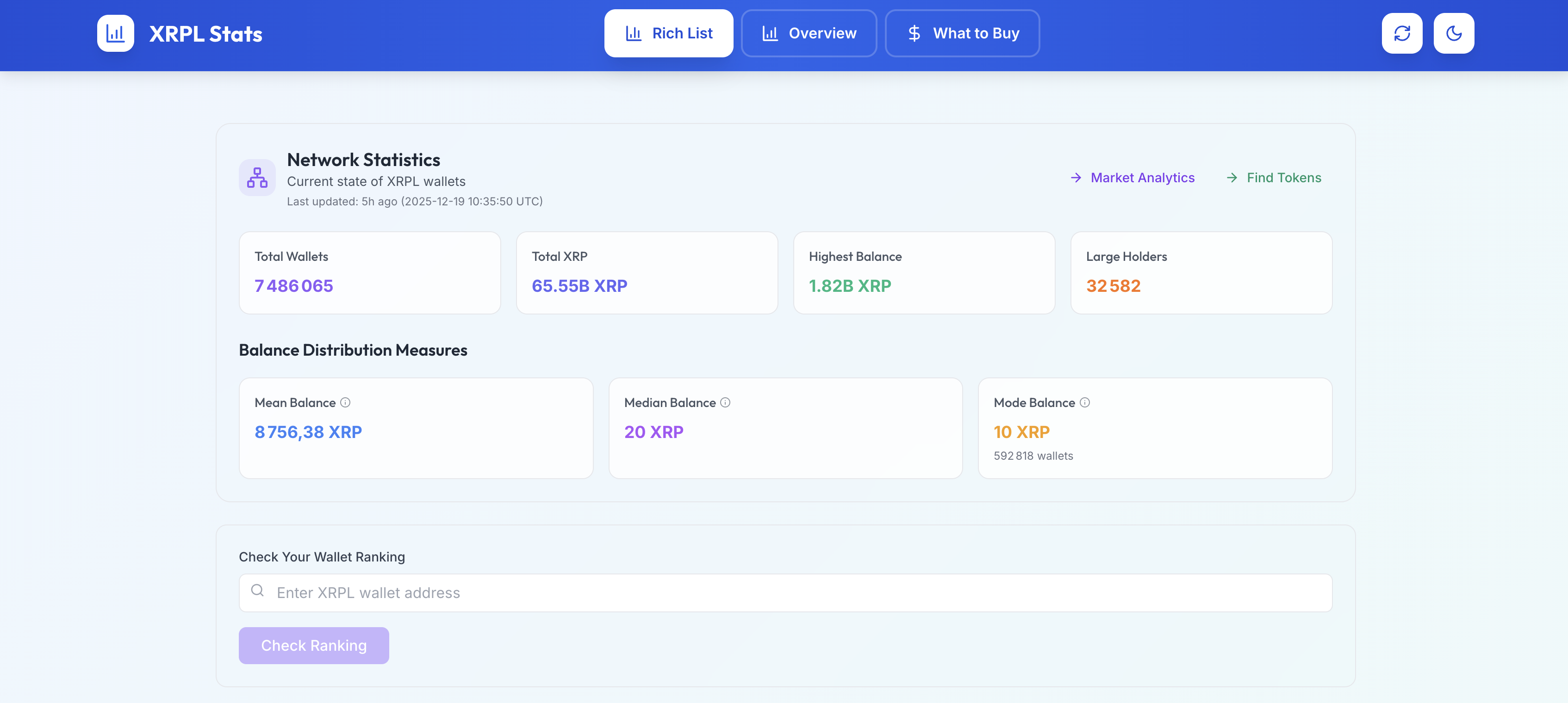
With no coding experience, I built xrplstats.com, a live analytics dashboard for the XRP Ledger. No hired developers. No startup budget. Just clear goals, XRPL knowledge, and a well-structured AI workflow. This isn’t theory. Here’s how it was built, step by step.
The idea
I wanted a dashboard that tracks real activity on XRPL: a high-level ecosystem overview, the number of wallets and their balances, and maybe a mini-game. While bits and pieces already did exist, it is always more fun using something you built yourself, so I decided to do just that.
The challenge: I’d never written code before. I understood XRPL mechanics, how trustlines work, and how to interpret transactions, but I wasn’t a developer. The best part—I didn’t need to be.
Planning and prompting
I started by describing the idea to GPT-4 and Claude (two heads are better than one!). They broke it down into clear components: frontend, backend, database, and deployment. For each part, I asked questions, challenged the answers, and iterated.
This wasn’t copy-paste. It was interactive. I reviewed and refined everything. While your coding is passive, your thinking is active. This is the trade-off: if you have no skills in coding, you must master communication.
Frontend
I built the interface in React. Claude generated the layout and logic. I connected it to XRPL APIs (ripple S1 and S2, XPMarket) to fetch and display real-time data. I asked the AI to explain each line of code so I could tweak and expand.
Within a day, the base UI was functional.
Backend
Now, this was the hardest part. The beauty of the front end is that you actually see what you built, but with the back end, it’s like magic… You won’t know until the last step.
To store historic data, I needed a backend script. Claude generated a Python process to pull XRPL within specific time frames. It started with SQLite, but I later upgraded to PostgreSQL for performance. Funny thing: I still have no idea which one is better or how they differ! I had to trust AI. If it works, it isn’t broken!
Scheduling, retries, logging, and basic data cleaning were all guided by AI, with me supervising logic and accuracy. And make no mistake, supervision is required.
Deployment
Everything was deployed to a Hetzner Cloud. I used AI to configure Ubuntu, install NGINX, enable HTTPS, and secure the server. No experience beforehand. Just step-by-step, question-by-question instructions.
The full pipeline - from data capture to visual output - was now live.
What made this work
I didn’t learn to code. I learned how to describe what I wanted, read responses critically, and made decisions. The AI filled the technical gap. What mattered was product sense, XRPL understanding, and iteration.
If you’ve worked in this ecosystem before, you already know enough. You understand tokens, memos, account flags, source tags, and network limitations. That’s the real prerequisite. The rest can be prompted.
Why now is the right time
The XRPL ecosystem is still early. It lacks dashboards, analytics tools, consumer apps, and wallet utilities. If you launch something today - even something simple - it stands out. This might not be true in a year with ever-increasing competition.
The tooling space will get competitive. Teams will scale. Expectations will rise. But right now, a working prototype is enough. You don’t need a grant, co-founder, or budget. Just an idea (free), a domain (5$), and an AI with cloud hosting (20-30$ per month). Prompt, test, deploy. You’ll learn more in a weekend than in a month of theory.
This hands-on experiment didn’t just end with a side project. It fundamentally reshaped how we work at XPMarket itself. Instead of spending hours debating product ideas or design decisions, we now fire up an AI assistant, build a quick MVP, and use that as a foundation to iterate and refine. This approach improves communication, accelerates timelines, reduces development costs, and shortens the gap between idea and production. It's now our default workflow.
What’s next
While xrplstats.com is still not perfect, it is stable and used daily. The next challenge is scaling—caching, handling traffic, and keeping performance high. But that’s a separate story.
This one is about the first build. What matters is that it was done quickly, affordably, and without traditional development.
Anyone in the XRPL community can do the same. The only question is who chooses to.



.jpg)