


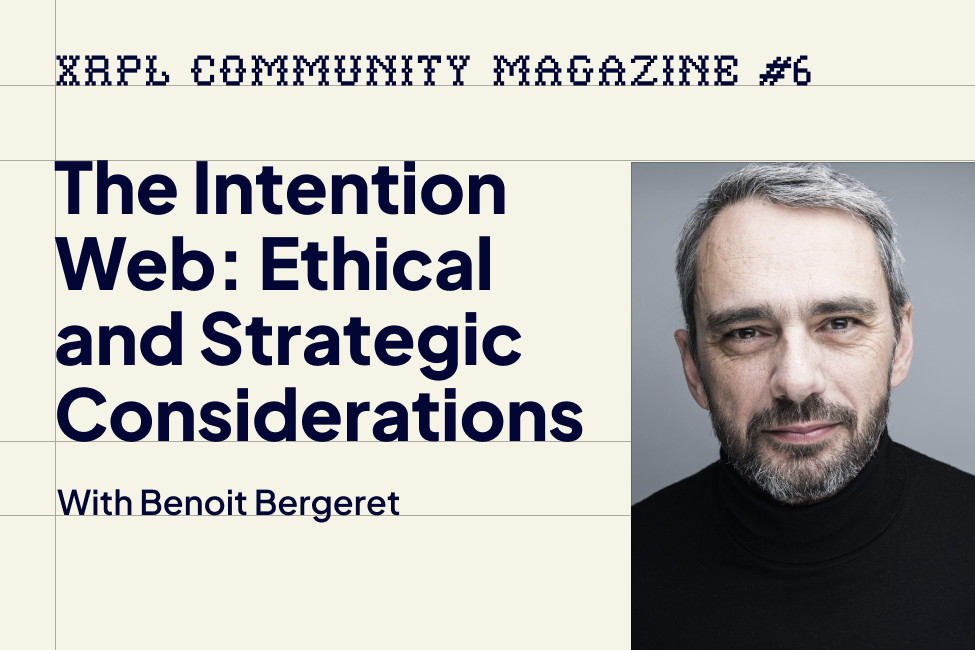
Interview by Simon Luling
What are your thoughts on the "Post Web" concept? What roles do AI and blockchain have therein?
As an AI practitioner watching blockchain mature, I think we are witnessing the emergence of the "intention web", moving towards autonomous software agents that negotiate, transact, and optimize on our behalf. Agents are only one expression of an AI stack that is simultaneously shrinking (Small Language Models), deepening (world models), and hybridizing (neurosymbolic reasoning).
I see this evolution as favoring blockchain architectures like XRPL, because they prioritize efficiency and real-world usefulness over energy-intensive consensus mechanisms. The pairing seems compelling, with AI supplying the cognition layer (sensing, reasoning, decision-making) and the ledger providing the trust infrastructure. However, technical challenges remain: how do we establish interoperability between AI inference models and blockchain settlements? What about governance mechanisms that can adapt to AI-driven decisions? Are there business models that make this integration complexity viable?
What will be the key use cases at the intersection of blockchain and AI technology?
The most compelling opportunity I see is AI enhancing blockchain applications: Intelligent transaction routing that optimizes fees and predicts congestion across networks; real-time fraud detection systems analyzing DeFi transaction patterns; predictive tokenomics models that stress-test governance proposals before implementation; or dynamic fee optimization responding to demand fluctuations in real-time.
Regarding XRPL, it could be suitable for deploying AI-driven agents that automate complex financial strategies, DeFi tasks, and cross-market trades. Real-time AI service marketplaces (Bittensor, Render, Akash) could potentially benefit from the ledger’s speed and economy, but integration will take time. XRPL also looks well suited for cross-border AI data monetization, though challenges around programming logic and compliance might make it difficult to implement complex regulations required for large-scale, regulated cross-border data flows.
On the ethical front, will blockchain bring AI away from real/perceived lack of transparency (the "black box AI" problem)?
Blockchain's audit capabilities may become valuable for AI governance, but the solution is more nuanced than often presented. Blockchain adds genuine transparency value in tracking training data provenance, model version control (cryptographic hashes of model checkpoints, hyperparameters, and training configurations), decision audit trails (high-stakes AI decisions logged with tamper-proof timestamps), or possibly compliance verification (zero-knowledge proofs demonstrating AI systems meet regulatory requirements without revealing proprietary model details). The same pattern extends to SLM checkpoints and neurosymbolic rule‑sets, whose smaller footprint could make on‑chain anchoring inexpensive and legally defensible. But the efficiency of the underlying blockchain matters significantly. Recording every AI inference on-chain would be prohibitively expensive on most networks. Ledgers such as XRPL may make comprehensive audit trails economically viable for high-value decisions. Ultimately, I see blockchain as complementary to, not a replacement for, explainable AI research. The combination of blockchain audit trails with interpretable AI methods might offer the most promising path forward.
Like AI, would you consider blockchain a geostrategic asset? How and to what extent?
Having considered this question deeply for AI, I see important differences in how AI and blockchain function as strategic assets. AI is widely recognized as a General Purpose Technology because it drives productivity gains across virtually all sectors and serves as a foundation for other technologies. In contrast, blockchain’s strategic value is more domain-specific, centering on financial infrastructure and data integrity. This makes its strategic profile closer to that of critical infrastructure (like industrial IoT or 5G networks) rather than a broad technological catalyst.
The landscape is also evolving: advances in smaller, verifiable AI models mean substantial capabilities can now be deployed with limited computational resources, undermining the need for massive, centralized AI infrastructure. This shift, paired with blockchain’s ability to anchor models and data on-ledger, is dispersing strategic leverage away from a handful of hyperscale players to those who excel at data stewardship and algorithmic innovation.
In practice, nations that control scalable blockchain infrastructure (especially for financial settlements) may gain an edge in international commerce and monetary policy. However, blockchain’s strategic impact today remains largely focused on specific applications like international finance and supply chain authentication, rather than enabling broad economic transformation.
Ultimately, both AI and blockchain do function as geostrategic assets by lowering barriers to capital movement, information flow, and regulatory enforcement. However, they also introduce new systemic risks, such as security vulnerabilities, political instability, and regulatory fragmentation—underscoring that their strategic value is closely tied to how they are governed and deployed.
How can AI help blockchain applications achieve transformation in the digital sphere?
The synergy between these two technologies is, in my view, where some of the most immediate and meaningful digital breakthroughs are likely to happen: Starting with network optimization, where AI stands to make blockchain far more efficient. Machine learning models analyze live network data to predict congestion and recommend the best timing for transactions. AI is checking on the performance and trustworthiness of validators. AI-powered agents comparing network conditions, automatically routing transactions across different chains, UX improvements, real-time risk assessment, etc.
With AI, tokenomics can become adaptive: picture a protocol that continuously tweaks supply, reward, or fee parameters by learning from real-time usage and economic signals. AI-powered agents could rebalance and optimize yields across dozens of DeFi protocols with minimal manual oversight.
And then there's the real-world integration, the real frontier for digital transformation. In supply chains, IoT sensors could feed real-time data to AI, which would automatically trigger blockchain-backed settlements the moment goods change hands, cutting paperwork and trust gaps. The energy sector might see blockchain-based, peer-to-peer trading platforms, where AI constantly optimizes grid loads and pricing for maximum efficiency. Financially, I envision AI managing complex strategies for institutions, executing trades and settlements automatically across global markets with blockchain’s security and transparency as the backbone.
Having experienced the rapid pace of progress in multiple tech areas, my sense is we’re just at the start of what AI and blockchain can do together in the digital sphere.
Beyond Agents: Three AI Paradigms That Matter
Agents are in the limelight, yet they are only one face of a fast‑diversifying AI stack. Three parallel tracks deserve equal attention because they map cleanly to complementarity with the blockchain.
Small Language/Vision Models are sub‑billion‑parameter networks trained on curated, debiased datasets; I can picture them embedded in a wallet plugin. Their tiny checkpoints fit inside a cheap on‑chain hash anchor, giving auditors a single‑source‑of‑truth for “what was deployed when”.
World-Model Architectures are AI systems that learn internal simulations of their environment, allowing them to imagine and evaluate multiple possible futures before taking action, ultimately enabling risk-free, pre-transaction simulations that let users test complex multi-step decentralized finance (DeFi) workflows virtually.
Neurosymbolic/Hybrid AI stacks neural nets atop symbolic rule engines. Each inference leaves a deterministic logic trace that pairs neatly with XRPL’s tamper‑proof logs; regulators get a line‑by‑line “why” instead of a black‑box “trust me.”




.jpg)


