



On April 7, 2026, XRPL Commons and Global Digital Finance (GDF) convened a select group of senior executives in Paris for an invite-only roundtable on stablecoins. Moderated by Odelia Torteman, Corporate Adoption Director at XRPL Commons, the panel featured Christian Rau (Senior Vice President of Global Digital Commercialization at Mastercard), Pierre d’Ormesson (Partner at DLA Piper), and Arthur van Lier (Managing Director Europe at Mesh Connect).
The discussion was framed by keynote insights from Martin Bruncko, Founder and CEO of Schuman Financial, along with an overview of the EU MiCa regulation landscape by Juan Ignacio Ibañez (General Secretary at the MiCA Crypto Alliance).
The headline? Stablecoins have crossed the inflection point. The conversation has shifted from whether to how.
The Business Case Arrived in Real Time
The evening opened with a live illustration no slide deck could have planned. TARGET2, the Eurosystem's primary interbank payment settlement system, was offline from April 2 to 7 over the Easter holiday. Salary payments were delayed. Large interbank transfers across Europe, including significant French welfare disbursements, were stuck in the queue.
As Pierre d’Ormesson, from DLA Piper noted: "This is the true business case for mass adoption of stablecoins as payment settlement instrument. To allow people to be paid 24/7, and not wait for TARGET2 to come back online."
It is the kind of friction that stablecoins, by design, eliminate. Settlement that runs 24 hours a day, seven days a week, without dependency on legacy banking windows. Christian from Mastercard framed it simply: "Everything that's happening in fiat today should be equal to implement in stablecoins."
Martin Bruncko, Founder and CEO of Schuman Financial, described how Schuman are building the core infrastructure for euro-denominated digital finance, issuing EURØP – a MiCA-compliant, fully euro-backed stablecoin that brings European payments, FX and DeFi use cases on-chain for institutions and builders.
Stablecoins as the Silent Engine
Mastercard's approach offers a useful model for how large payments networks and financial institutions are integrating stablecoins. The bet is not on a crypto-forward consumer product. It is on stablecoins as the settlement engine underneath existing infrastructure. Invisible to users. Meaningfully better on speed, cost, and transparency.
Christian pointed to a real use case. Mastercard is experimenting with Ripple USD (RLUSD), a regulated USD-denominated stablecoin, settlement on the XRPL (XRP Ledger) for its programme with Gemini, a leading US crypto exchange. As Odelia Torteman highlighted, this is one of the first instances of a regulated US bank settling directly on a public ledger. Most comparable use cases run on private or permissioned chains. The significance should not be understated.
B2B payments, often cross-border, are the largest near-term opportunity. Transparency on payment status, cost predictability, and speed across key global corridors are use cases stablecoins address today.
Pierre d’Ormesson was direct: "TARGET2 (the Eurosystem's primary interbank payment settlement system) was offline from April 2–7 over Easter. Salaries delayed. Large interbank transfers were stuck. This is the true business case for mass adoption of stablecoins as payment settlement instrument: to allow people to be paid 24/7."
As Odelia Torteman framed it “The question now has shifted- Not whether stablecoins belong in institutional strategy, but rather how fast institutions decided to move, and on which infrastructure”.
The Regulatory Friction That Still Matters
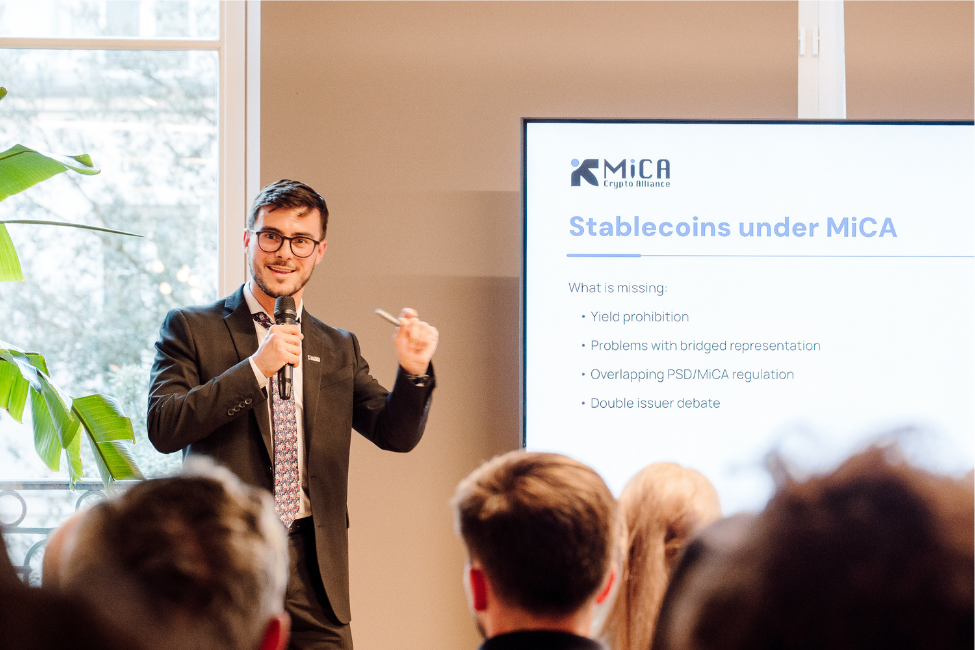
Europe's MiCA (Markets in Crypto-Assets) regulation has brought meaningful structure. But significant pressure points remain, and both Juan Ignacio Ibañez -General Secretary at the MiCA Crypto Alliance and DLA Piper partner Pierre d’Ormesson walked through them clearly.
Yield prohibition. MiCA bans yield-bearing stablecoins. This sometimes has a side-effect: it pushes users toward unregulated DeFi intermediaries to access returns, creating the very opacity regulators sought to avoid.
Basel treatment. Under the current Basel taxonomy, the global framework for bank capital requirements, certain stablecoins (ARTs) can fall into Group 1B assets, attracting a 250% prudential exposure weighting, meaning banks must hold 2.5x the capital against some stablecoin holdings. For banks, this makes balance sheet allocation prohibitively expensive.
Systemic risk. The European Systemic Risk Board flagged two concerns in its November 2025 report: structural outflows from bank deposits into stablecoins, and coordinated redemption (run) risk if confidence breaks.
Tokenized bank deposits (blockchain-based representations of traditional bank deposits) are emerging as an alternative worth watching. They can be remunerated, the underlying deposit benefits from deposit guarantee schemes, and have clearer inter-bank acceptability.
Juan Ignacio Ibañez from MiCa Crypto Alliance highlighted additional important gaps that MiCA still leaves open, including the unresolved issues around bridged representations of assets, overlapping PSD/MiCA requirements, and the ongoing “double issuer” debate.
One forward-looking point is MiCA 2: discussions are already underway. The forthcoming EU report on DeFi regulation will also be a defining moment.
Fragmentation Is an Opportunity. For Now.
With 40+ euro-denominated stablecoins in circulation and more arriving regularly, fragmentation is accelerating. For Arthur at Mesh Connect, this is good news. "The more fragmentation, the more value we add. Please keep them coming." Mesh's on-chain orchestration layer, an infrastructure that routes and converts between different stablecoins and blockchains automatically, thrives on complexity. If a merchant wants to receive USDC on Base and the client only holds BTC (Bitcoin), Mesh handles the conversion end-to-end.
That said, the panel agreed consolidation is coming. Regulatory moats, not just technical ones, will determine which Layer 1 blockchains (L1s) and issuers survive long-term. Profit margins for stablecoin issuers, currently high due to yield earned on dollar reserves, will compress as competition intensifies.
One signal worth watching: Meta recently issued a new tender around stablecoin infrastructure. A second attempt at a global consumer stablecoin, following the collapse of Libra in 2019, may be closer than the market expects.
Value Fluidity. The Chapter After Payments.
Arthur introduced what may be the session's most consequential idea: value fluidity. The notion that stablecoins are not just payment instruments, but the connective tissue enabling seamless movement between cash, tokenized assets (blockchain-based representations of real-world assets like equities, bonds, or property), and on-chain credit.
If a consumer can hold tokenized Apple shares or gold and pay at point of sale directly, the distinction between money and assets starts to collapse. Credit follows the same logic: collateralising tokenized assets for on-chain loans is currently accessible only to sophisticated players. The infrastructure being built today is what brings it to everyone else.
As Arthur put it: "What we're building now is a foundation for what's next." T+0 settlement of real-world assets, which seemed aspirational in 2020, is now an engineering problem. Stablecoins are the required cash leg.

What the Panel Is Watching Over the Next Five Years
- Arthur, Mesh Connect. On-chain infrastructure maturing to support tokenized real-world assets at scale.
- Pierre d’Ormesson], DLA Piper. MiCA 2, the EU DeFi regulatory report, and the potential emergence of a CASP agent status (Crypto Asset Service Provider, a regulated category under MiCA) and distributor tier in Europe.
- Christian, Mastercard. Adoption is driven by value, not crypto literacy, where consumers never need to know or care about the underlying rails.
- Odelia Torteman, XRPL Commons. Stablecoins as the foundation layer, not just the end product, supporting diverse other use cases including on- chain credit and lending.
Q&A: Quick Answers for the Questions We Get Most
What is a stablecoin? A stablecoin is a digital currency designed to maintain a stable value, typically pegged 1:1 to a fiat currency like the US dollar or euro. They run on blockchain networks and enable fast, programmable settlement without the volatility of assets like Bitcoin.
What is MiCA and why does it matter? MiCA (Markets in Crypto-Assets) is the European Union's regulatory framework for digital assets, including stablecoins. It establishes licensing, reserve, and operational requirements for issuers. It is the most comprehensive stablecoin regulatory framework in force globally as of 2025.
Why can't stablecoins pay yield under MiCA? MiCA prohibits EMTs (e-money tokens, the category covering most euro stablecoins) and ARTs from offering interest or yield to holders. The rationale is to prevent unregulated entities from effectively offering deposit-like products. Many in the industry expect this to be revisited in MiCA 2.
What is the XRPL and why is it relevant to stablecoins? The XRP Ledger (XRPL) is a public L1 blockchain optimised for fast, low-cost payments and asset settlement. It supports the issuance of stablecoins and tokenized assets, and is one of the few public ledgers currently being used for regulated institutional settlement (as in the Mastercard/Gemini/RLUSD example discussed at this roundtable, among many others).
What is tokenization? Tokenization is the process of representing real-world assets (equities, bonds, real estate, commodities) as digital tokens on a blockchain. It enables faster settlement, fractional ownership, and programmable transfer of assets that traditionally require intermediaries and days to move.
When is the next XRPL Commons roundtable? We will announce our next executive roundtable later in 2026. Sign up to our mailing list to be the first to hear.



.jpg)


